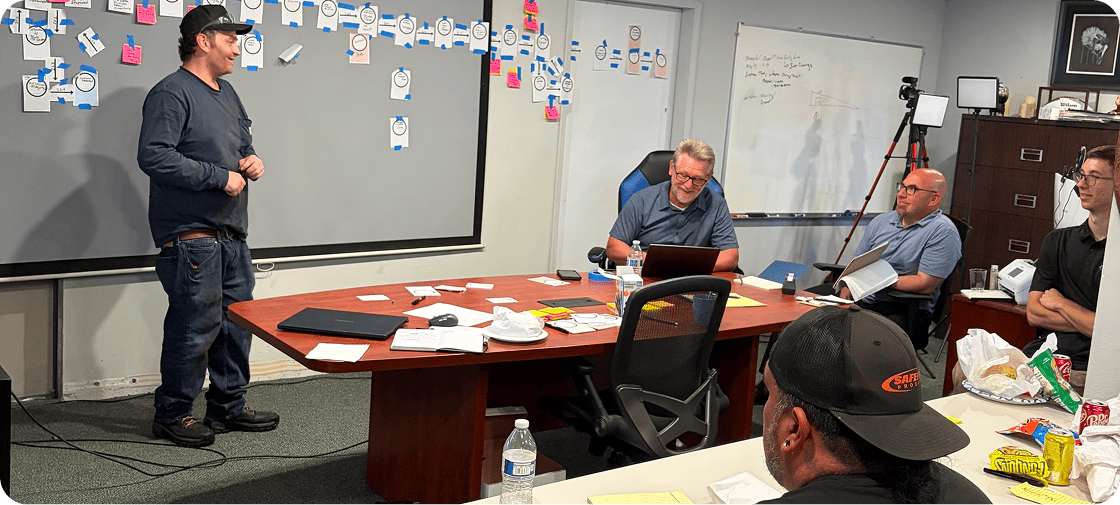
A structured, visual, on-site way to see how your organization works and fix what matters most. Your team builds it on one page, from their perspective.
You walk away with an accurate picture of the work, the pain located and ranked, and a team that owns the fixes because they drew the map.
The Systems map
Every core system, support system, and process on a single page, the SoftS Map, so the whole organization is visible at once. Not the org chart, the work: departments as interconnected systems, not silos.
01
Measure
Put a number on it, and the number that matters most is time: how long from the moment a need arrives to the moment something meaningful comes out the other end. Speed is capacity.
02
Action/Result Mapping
Separates quick wins from structural fixes, then runs the work through Analyze, Design, and Train before you ever Enforce.
03
Find the pain
Mark exactly where the work snags,
using the Three Rules of Pain, so the
conversation stays about systems and never turns into a trial. Named precisely and without blame.
04
Triage
Rank the pain by how often it happens, how much it costs, and how fixable it is, with the people closest to the work weighing in, because they live the consequences daily. Quick wins get
separated from structural fixes, so effort goes where it pays off first.
05
Develop an Action Plan
Every priority leaves the room with a
named accountable person, a defined
outcome, a real deadline, and a mid-point check-in, then moves through the ADTE gates. Insight without an owner evaporates.
06
The Three Rules of Pain
Naming a problem usually feels like naming a person, which is why most improvement efforts stall. These three rules take the threat out of the room.
Pain is never a person.
About 94 percent of problems live in the system, not the people running it. So we talk about the step that fails, never the person standing near it, and nobody has to get defensive.
Pain has a frequency.
"Always" and "never" start fights; a percentage starts a conversation. A problem you can count is a problem you can solve.
Pain has a location.
"Intake is broken" is a feeling. "At step 20, the documentation arrives incomplete 40 percent of the time" is a set of coordinates, and you can't fix what you can't point to.
How we gate the fixes: ADTE
When something fails, most organizations jump straight to enforcement: a new rule, a
stern memo, a name on a performance plan. Nothing changes, because enforcement was
never the missing piece. ADTE is how we gate the fixes: four stages in a deliberate order,
each one earned before the next opens.
Analyze
Before anything gets fixed, we make
sure the team is solving the actual root
cause, not the loudest symptom. Most
"obvious" causes don't survive this
gate.
Design
The better way gets built with the
people who run the process, not for
them. A fix designed at a distance gets
worked around; one built by the people
who live it gets defended.
Train
Everyone is genuinely equipped to
succeed at the new way before anyone
is measured against it. This is the gate
most organizations believe they've
cleared and haven't.
Enforce
Now, and only now, accountability is
fair, and because it's fair, it sticks. And
when enforcement still fails, it's telling
you an earlier gate didn't truly clear.
With your team, never to them.
Leaders are often too inside the work, and too senior, to be told the truth by
their own staff. That's what we're for: a method built as a partnership, not an
audit, where we guide, and your departments and teams do the mapping with their own hands. People defend what they helped build.
Ready to see your organization clearly?
The fastest way in is a short conversation or by starting with the SoftS Quick Start, built for your first 60 days.